AI pipeline · RAG
AI Video Studio
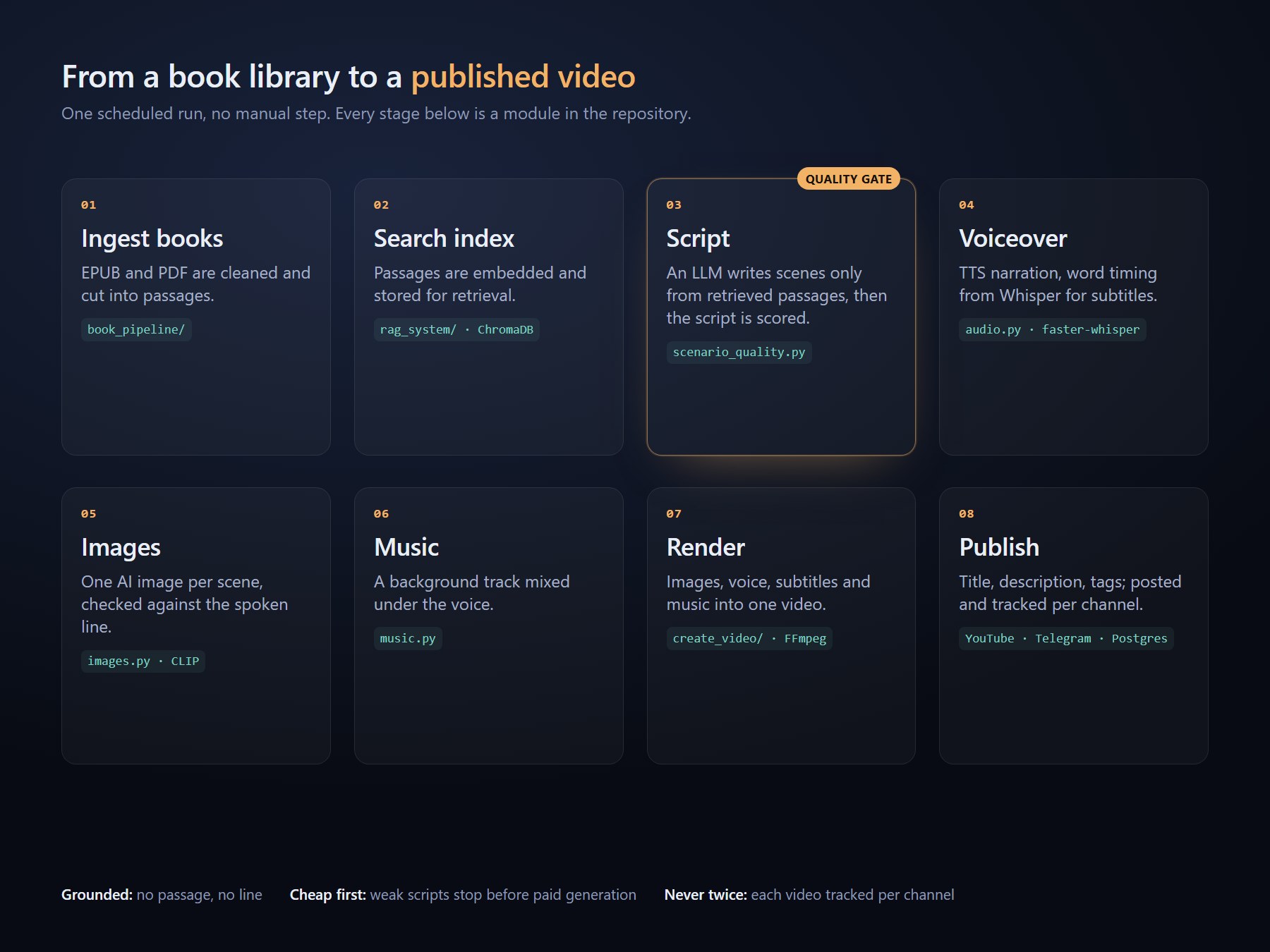
From a library of books to a narrated, illustrated video: the script is written from retrieved passages, checked before money is spent, then voiced, illustrated, rendered and published.
- 8stages, no manual step
- 1quality gate before paid generation
- 3TTS providers with fallback
- RAGscripts written from sources
The problem
Running a content channel by hand means research, an accurate script, voiceover, visuals, music, editing and upload for every video. Letting a model write from memory is fast and quietly wrong.
How it works
- 01
Ingest sources
Ebooks and PDFs are extracted, cleaned and chunked.
- 02
Build the index
Chunks are embedded with sentence-transformers and stored in ChromaDB.
- 03
Grounded script
An LLM writes scene by scene from retrieved passages. A quality score can reject the script before any paid step runs.
- 04
Voice and timing
TTS from several providers with fallback; faster-whisper gives word timings for subtitles.
- 05
Pictures and music
An image per scene, checked against the spoken line with a CLIP-style model, then music under the voice.
- 06
Render and publish
MoviePy and FFmpeg render the video; title and tags are generated and each video is tracked per channel before upload.
Limits I know about
- It grew out of a 2024 content pipeline; the public repository is a cleaned-up version of that work.